Hot tub vs sauna, decided on what each one actually does
Ready to compare? The hot tubs and saunas we link →
Some links are affiliate links; if you buy through one we may earn a commission, and it never changes what we recommend. Disclosure.
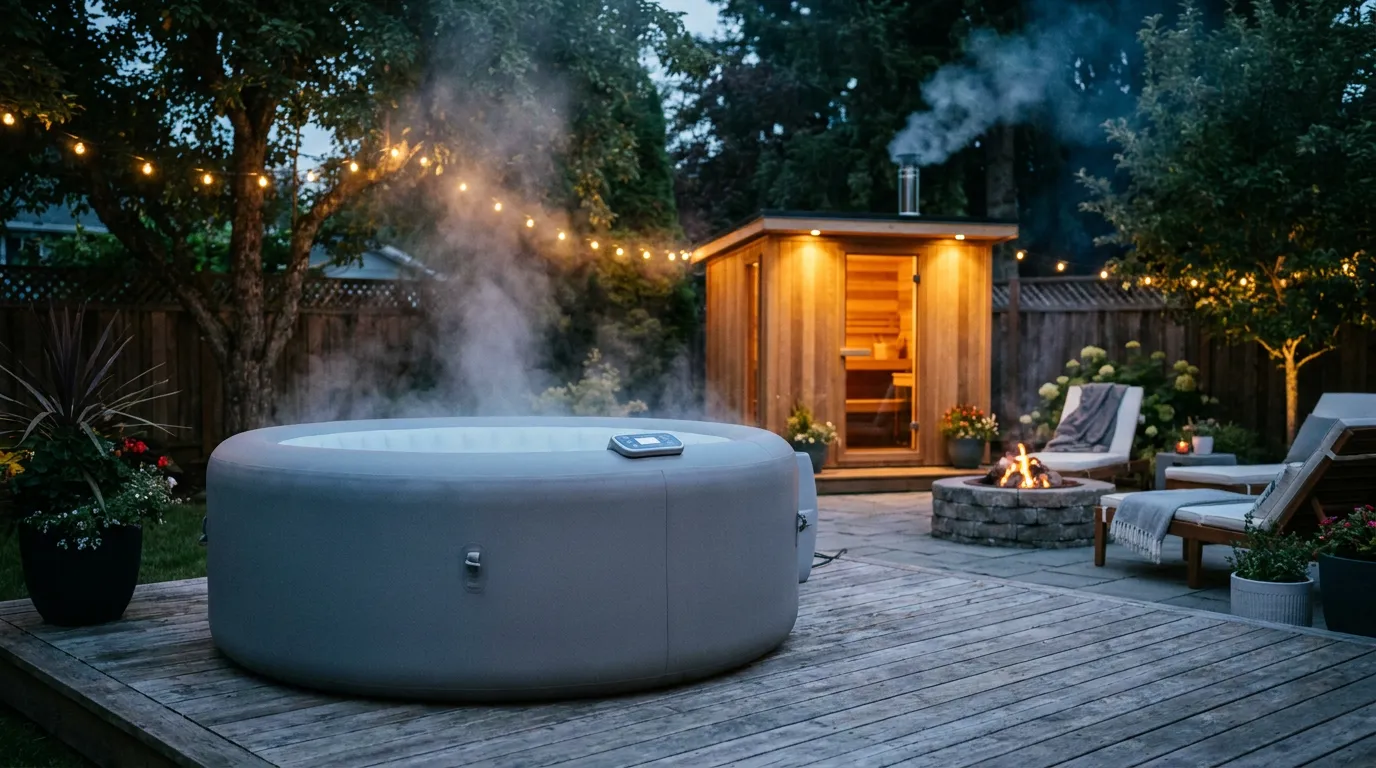
Most people asking hot tub vs sauna want the same thing from both: an evening that undoes the day, deeper sleep, looser joints, a reason to stop for twenty minutes. As a wellbeing professional who has spent his career helping organisations manage health, stress and recovery, I'd put it this way: they share the word "heat" and not much else. A sauna surrounds you with hot air; a hot tub puts you in hot water, and water moves heat into the body far faster. The evidence is not balanced between them either. The strongest long term data on heat and health comes from a 20.7 year Finnish cohort of traditional sauna users (Laukkanen et al., JAMA Internal Medicine, 2015). Below is the honest comparison on what each does to your body, what the research does and does not show, what they cost to buy and run, and who should pick which. This site earns a commission if you buy through a link below, at no extra cost to you.
Side by side
Temperature is the number everyone compares, and it is the least useful one. What matters is how fast each moves heat into you, what the research behind each actually measured, and what owning one asks of you every week.
| Hot tub | Sauna | |
|---|---|---|
| How it heats you | Hot water up to 104°F, your body submerged to the shoulders | Hot air, about 150–195°F in a traditional sauna, lower in infrared |
| What the body does | Core temperature climbs fastest, because water carries heat far better than air | A gentler core rise in a traditional sauna, almost none in infrared at the same session length |
| Long term evidence | One large Japanese cohort on ordinary daily tub baths and heart disease and stroke | Two decades of Finnish cohort data on cardiac death, all cause death and dementia |
| Buy price, products we link | $750 to $2,200, Wave Spas portable tubs | $4,950 for the Peak Crown 2 person infrared, $9,245 for Sweat Kingdom's traditional 4 person cabin with heater |
| Power | A heater Wave lists at both 1,350W and 1,800W, plus a 600W bubble blower: about 0.26 to 0.34 an hour while heating | The Crown plugs into a standard 120V outlet; traditional cabins usually need a 240V circuit |
| Upkeep | Water chemistry every week, filters, a cover, drain and refill | Wipe the benches, nothing to test or dose |
| Best for | Social soaking, sore joints, a warm bath before bed | The cardiovascular and longevity evidence, solo or paired ritual |
Why water heats you faster than air
A sauna at 180°F feels survivable because air is a poor conductor and your sweat evaporates off your skin, cooling you as it goes. Sit in 104°F water and neither of those helps: water conducts heat into you far more readily than air does, and sweat cannot evaporate from skin that is underwater. That is why a hot tub feels mild for the first few minutes and then catches up with you.
A 2025 crossover trial measured exactly this in 20 healthy adults, comparing 45 minutes in 40.5°C (105°F) water, three 10 minute rounds in an 80°C (176°F) traditional sauna, and 45 minutes in an infrared sauna.
A smaller 2022 study of 13 adults found the same direction from the other side: a humid 55°C sauna was less well tolerated and put more strain on the heart than 40°C water (Campbell et al., Experimental Physiology, 2022). The practical point is not that one is "stronger". It is that a hot tub session needs the same respect as a sauna one, even though the number on the panel is half as high.
What the research does and does not show
The sauna's case rests on cohort data with long follow-up. In the Finnish study, men who used a traditional sauna 4 to 7 times a week had a hazard ratio of 0.37 for sudden cardiac death against once a week users, and a later analysis of the same cohort found markedly lower dementia risk. Two caveats matter: it is observational, so it shows association, not cause, and it measured traditional Finnish saunas, not infrared cabins.
The closest hot water equivalent is a Japanese cohort of 30,076 adults aged 40 to 59, followed from 1990 to 2009. Those who bathed daily had a hazard ratio of 0.72 for total cardiovascular disease and 0.74 for stroke, against those bathing up to twice a week (Ukai et al., Heart, 2020). It is a genuinely encouraging result, but it studied ordinary Japanese home baths, not hot tubs, and it found no link with sudden cardiac death.
Where the hot tub has a clear edge is sleep. A meta-analysis of 17 studies found that water at 40 to 42.5°C, used one to two hours before bed, improved self-rated sleep quality, and as little as 10 minutes shortened the time it took to fall asleep (Haghayegh et al., Sleep Medicine Reviews, 2019). Those were baths and showers, but a hot tub delivers the same warm water exposure. Graded side by side:
| Claim | Evidence grade | What the research actually says |
|---|---|---|
| Frequent traditional sauna use tracks with lower cardiac death | A | Finnish cohort, 2,315 men, 20.7 years: 4 to 7 sessions a week against once weekly, hazard ratio 0.37 for sudden cardiac death. Traditional sauna, observational, not proof of cause. PMID 25705824 |
| Daily tub bathing tracks with lower heart disease and stroke | B | Japanese cohort, 30,076 adults aged 40 to 59 followed from 1990 to 2009: daily bathing against 0 to 2 times a week, hazard ratio 0.72 for total cardiovascular disease and 0.74 for stroke. Ordinary home baths, not hot tubs, observational. PMID 32209614 |
| A warm bath before bed helps you fall asleep | B | Meta-analysis of 17 studies: water at 40 to 42.5°C (104 to 108.5°F), 1 to 2 hours before bed, improved self-rated sleep quality, and as little as 10 minutes shortened the time to fall asleep. Baths and showers, not hot tubs specifically. PMID 31102877 |
| Hot water raises core temperature more than a sauna does | B | Crossover trial, 20 healthy adults: 45 minutes in 40.5°C water raised core temperature 1.1°C, three 10 minute rounds in an 80°C sauna 0.4°C, and 45 minutes of infrared 0.0°C. Small and short term. PMID 40332494 |
| Hot tubs detoxify the body | D | No study we found supports it, for a hot tub or a sauna. Sweat is mostly water and salt. |
What they cost to buy and run
On the products we link, a hot tub is the cheaper buy. Wave Spas' portable tubs run from $750 for the inflatable Pacific to $2,200 for the dearest Garda, and the Eco Foam Tahoe starts at $1,500. The lowest priced sauna we link, the infrared Peak Crown, is $4,950, and Sweat Kingdom's traditional 4 person cabin with its heater is $9,245.
Running costs are harder to compare honestly. Wave's tubs use a heater it lists at 1,350W in one place and 1,800W in another, about 0.26 to 0.34 an hour at the US average electricity rate while it runs, plus $0.11 an hour for the 600W bubble blower. How many hours the heater runs depends on your climate, your cover and how often you soak, and Wave publishes no US daily figure, so we do not invent one. A sauna sits cold between sessions and only draws power while you heat it and use it; put your own numbers into the cost-to-run calculator for that side.
The cost that rarely makes the comparison is time. A hot tub is a body of warm water that needs its chemistry tested and adjusted, filters looked after, and periodic draining and refilling. The CDC names the two infections that follow when that slips: hot tub rash, caused by the germ Pseudomonas aeruginosa, and Legionnaires' disease, from breathing in mist that contains Legionella. A sauna needs its benches wiped. If the weekly chemistry is a chore you will skip, that alone can settle the question.
Safety, stated plainly
The CDC's hot tub guidance is short and worth following to the letter: water no higher than 104°F, no alcohol before or during, no children under 5, and a conversation with a healthcare provider first if you are pregnant. That last point has data behind it. In a cohort of 1,063 pregnant women, hot tub use was linked to roughly double the risk of miscarriage (Li et al., 2003), and in a study of 23,491 women, hot tub use in early pregnancy was linked to a higher risk of neural tube defects (Milunsky et al., JAMA, 1992). Because water raises core temperature faster, this caution applies to a hot tub at least as much as to a sauna. If you have a heart condition or take blood pressure medication, ask your doctor before starting either.
The hot tubs we link
Wave Spas sells portable tubs, not built in spas: an inflatable, and two Eco Foam models that Wave says insulate 60% better than traditional inflatables. All three heat to a 104°F maximum, with a heater Wave lists at 1,800W in its feature list and 1,350W in its spec tab. Sizes, water weight and setup for every Wave tub are in best hot tubs. Their terms, read from Wave's own pages:
- Warranty: 2 years on the heater, 12 months on the liner, integrated heater models. Applies to the inflatable and foam spas with an integrated heater, which covers the Pacific, Garda and Tahoe. Other models get 12 months on the heater and 6 on the liner. Manufacturing faults only, wear and accidental damage excluded, and no claim is processed without photo or video evidence of the fault.
- Returns: 14 days to start a return, unopened only, you pay return shipping. Contact them inside 14 days before sending anything back. The spa must come back in the exact condition received and in its original packaging, and a spa with its seal opened cannot be returned unless it was faulty on arrival. A faulty item qualifies for a full refund within 30 days of receipt.
- Shipping: Free on orders over $50, FedEx, 3 to 5 business days. Inflatables ship in 3 to 5 business days and rigid foam spas in 5, both by FedEx to the mainland. Alaska carries an extra $1,800 charge.

Wave Tahoe, 4 or 6 person Eco Foam
The middle of the range: a foam walled portable tub with a built in heater, up to 104°F. Choose the size and finish on the product page.
from $1,500 · $1,500–$2,100 across 16 options, choose on the product page
In stock. Delivery: Free on orders over $50, FedEx, 3 to 5 business days. Returns: 14 days to start a return, unopened only, you pay return shipping.

Wave Garda, 4 or 6 person Eco Foam
The same heater and 104°F limit as the Tahoe in a different shell, and the dearest of the three.
from $1,800 · $1,800–$2,200 across 16 options, choose on the product page
In stock. Delivery: Free on orders over $50, FedEx, 3 to 5 business days. Returns: 14 days to start a return, unopened only, you pay return shipping.

Wave Pacific, 4 or 6 person inflatable
The low cost way to find out whether you will use a hot tub every week before spending more.
from $750 · $750–$1,080 across 18 options, choose on the product page
In stock. Delivery: Free on orders over $50, FedEx, 3 to 5 business days. Returns: 14 days to start a return, unopened only, you pay return shipping.
Recalls and warranties: what to check before any hot tub
People ask AI which hot tub brands to avoid. We do not keep a blacklist, but two checks separate a safe buy from a risky one, and both are public. First, the CPSC recall list: Watkins recalled about 32,900 Hot Spring Highlife spas from model years 2023 to 2025 in February 2026 because their hydromassage jets can trap hair (recall 26-268), and Sundance recalled about 23,700 Jacuzzi and Sundance tubs in December 2022 because their temperature sensor could report the wrong water temperature (recall 23-068). A recall that was fixed is not a reason to avoid a brand; one that is still open on the model you want is.
Second, the warranty, which is also one documented reason some big-box tubs cost less. The same maker, Watkins, sells a rotomolded tub through Costco under the Aquaterra name with a warranty (Aquaterra limited warranty, part number 62826 Rev H, 2023) of 5 years on the shell against water loss, 1 year on equipment and plumbing and 2 years on the cabinet. Its dealer-sold Hot Spring Highlife warranty gives 7 years on the acrylic surface and 5 years each on plumbing, components, heater and cabinet. A shorter warranty is not a defect, but it is part of what the lower price buys. The Wave Spas terms for the tubs we link are listed above.
The sauna side
If the evidence is what is moving you, the research points at a traditional sauna, a heater and rocks at 150°F and above. The cheaper route is infrared: the Peak Crown plugs into a standard outlet and reaches 150°F, but in the 2025 trial above, infrared raised core temperature far less than either hot water or a traditional sauna, and the Finnish data did not study it. More options, traditional and infrared, are in our best home saunas.

Sweat Kingdom Sweat Cabin, Blackout Edition
A 4 person traditional cabin, the type the Finnish cohort studied. Every option ships with an 8 or 9 kW heater; check its circuit needs with your electrician.
from $9,245 · $9,245–$11,545 across 6 options, choose on the product page
In stock. Delivery: $750 flat on modular saunas, curbside, contiguous US only. Returns: 30-day home trial, but not after assembly or use.

Peak Crown, 2 person infrared
A 2 person full spectrum infrared cabin that runs from a standard 120V outlet, the simplest sauna to put in a home. Infrared, so not the type the long term cohort studied.
$4,950
In stock. Delivery: Free in the continental US. Returns: 30 days, but a 25% restocking fee and you pay return shipping. This merchant's feed last updated in October 2026, so treat the price as that date rather than today's.
Who should pick which
What I'd tell a client weighing this: decide what you want the twenty minutes to do. If it is the long term cardiovascular case, buy the sauna, ideally traditional. If it is a warm, social end to the day that also helps you sleep, a hot tub does that well and costs less up front, as long as you will keep the water right every week.
- The evidence seeker. Sauna, traditional if you can. That is where the long follow-up cohort data sits.
- The household. A hot tub seats four to six and is something the whole family, or friends, will use together. Children under 5 should stay out.
- The poor sleeper. A warm soak an hour or two before bed has meta-analysis support. Either works, but the hot tub matches what those studies tested.
- Anyone pregnant, or with a heart condition. Talk to your doctor first, about both.
Want both? The pairing makes sense because they do different jobs, and if cold is part of your routine too, our contrast therapy protocol covers how heat and cold fit together.
Common questions
Is a hot tub or a sauna better for your health?
On the long term evidence, the sauna. A Finnish cohort of 2,315 men followed for 20.7 years tied 4 to 7 traditional sauna sessions a week to markedly lower cardiac death. The closest hot tub equivalent is a Japanese cohort on ordinary daily tub baths, which tied daily bathing to lower heart disease and stroke. Both are observational. A hot tub has its own strengths, a faster rise in core temperature and good evidence for a warm soak before bed, but nothing matching the sauna's depth of data. Not medical advice.
How hot is a hot tub compared with a sauna?
A hot tub tops out at 104°F, which is the CDC's stated limit and the maximum on the Wave Spas tubs we link. A traditional sauna runs about 150 to 195°F. The water still heats you faster: in a 2025 crossover trial, 45 minutes in 40.5°C water raised core temperature 1.1°C against 0.4°C for a traditional sauna session.
How much does a hot tub cost to run?
The Wave Spas tubs we link use a heater Wave lists at 1,350W on one part of its pages and 1,800W on another, and a 600W bubble blower. At the US average of $0.19 a kWh that is about 0.26 to 0.34 an hour while the heater runs and $0.11 an hour for the bubbles. Wave publishes no US daily figure, and the real number depends on your climate, the cover and how often you use it.
Who should not use a hot tub?
The CDC says to keep the water at or below 104°F, to talk to a healthcare provider first if you are pregnant, not to drink alcohol before or during use, and not to let children under 5 use one. Studies have tied hot tub use in early pregnancy to higher miscarriage and neural tube defect risk. If you have a heart condition, ask your doctor before using either a hot tub or a sauna.
Can I have both a hot tub and a sauna?
Yes, and the pairing works because they do different jobs: the sauna for the heat session the research is built on, the tub for a social soak or an evening wind down. Buying from the brands we link means two orders from two merchants, Wave Spas for the tub and a sauna maker for the cabin, with separate deliveries and separate warranties.
Sources & method
Evidence cited above: Laukkanen et al., JAMA Internal Medicine, 2015, Finnish cohort of 2,315 men, 20.7 years (PMID 25705824); Laukkanen et al., Age and Ageing, 2017, same cohort (dementia and Alzheimer’s risk) (PMID 27932366); Ukai et al., Heart, 2020, Japanese cohort of 30,076 adults (tub bathing and cardiovascular disease) (PMID 32209614); Haghayegh et al., Sleep Medicine Reviews, 2019, meta-analysis of 17 studies (warm bath or shower before bed) (PMID 31102877); Atencio et al., American Journal of Physiology, 2025, crossover trial of 20 adults (hot water, traditional and infrared sauna) (PMID 40332494); Campbell et al., Experimental Physiology, 2022, crossover study of 13 adults (water immersion and humid sauna) (PMID 35193165); Li et al., American Journal of Epidemiology, 2003, cohort of 1,063 pregnant women (hot tub use and miscarriage) (PMID 14607798); Milunsky et al., JAMA, 1992, 23,491 pregnancies (heat exposure and neural tube defects) (PMID 1640616); CDC, What You Can Do to Stay Healthy in Hot Tubs, page dated May 20 2025, read 2026-11-06 (source); CDC, Preventing Hot Tub Rash, read 2026-11-06 (source); CDC, Preventing Legionella from Hot Tubs, read 2026-11-06 (source); Wave Spas warranty and returns pages, read 2026-11-06 (source).
Hot tub heater and blower wattage (Wave states the heater as both 1,350W and 1,800W) and the 104°F maximum are from the Wave Spas Pacific, Tahoe and Garda product pages, read 2026-11-06; Wave publishes no US running cost, so hourly figures are shown and no monthly figure is estimated. Sauna temperature ranges are the accepted standard for traditional saunas. Product prices come from each merchant's daily Awin feed. The cohort studies are observational and show association, not cause. Nothing on this page is medical advice.