Fire
Home saunas
A home sauna is one of the few buys that pays you back in how you feel: recovery after training, stress that lifts in the heat, sleep that comes easier, and the heart health the sauna research keeps pointing to. An at-home sauna is also a $2,500-15,000 decision with three questions hiding inside it: what shape, what heat, and what it will cost to run. Get those right and the brand almost picks itself. Here's the map.
By Craig Fearn, Fellow of the Royal Society for Public Health, a wellbeing advisor who has spent his career on stress and recovery. Some links below are affiliate links, they never change our picks. Disclosure.
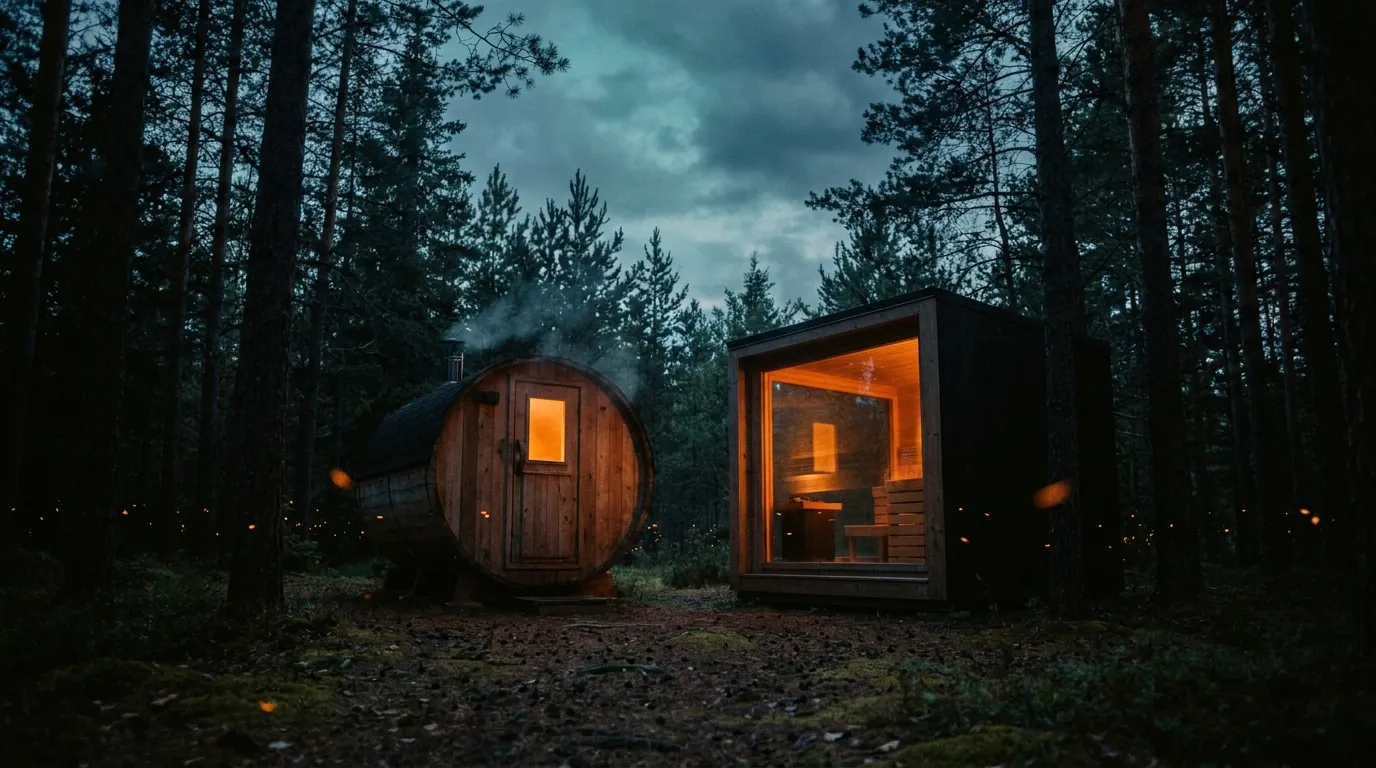
First, the shape
Barrel saunas
Cheapest way outdoors and the most photogenic, but uneven heat and higher running cost. →
Cabin saunas
Insulated, even heat, cheaper to run, the better buy for heavy or daily use. →
Both below are Sweat Kingdom, the merchant with the deepest verified lineup we track, so the price, photo and stock status are live, not a guess.

The Sweat Barrel (2-6 Person)
Red cedar barrel in 2, 4 and 6-person sizes, our best-value pick for the shape. The from-price is the 2-person shell; the 6kW Harvia or HUUM heater and the roof are options on top.
from $4,795 · $4,795–$9,895 across 36 options, choose on the product page
Made to order, 5-week lead time stated by the retailer. Price is for the unit and excludes delivery.

The Sweat Cabin (4 Person)
4-person insulated cabin, the better buy for daily use. The from-price is the cabin without a heater; Harvia 8kW, Homecraft 9kW and HUUM 9kW are the options.
from $6,495 · $6,495–$9,995 across 8 options, choose on the product page
Made to order, 5-week lead time stated by the retailer. Price is for the unit and excludes delivery.
Best home sauna by scenario
If you're browsing saunas for sale and the shape/heat split above still leaves two good options, this is the faster route in: pick the scenario closest to yours. Each link below is a full comparison, not a single product, so you can see the trade-offs before you commit. New to it all? Start with our best home saunas roundup.
Backyard: outdoor cabin saunas →
Insulated, weatherproof, built for a permanent spot outside.
Indoor, no electrician: infrared saunas →
Most run on a standard 120V outlet and fit a spare room.
Inside the house: indoor saunas →
The ventilation, moisture and power checklist before you build in.
Sharing it: 2-person saunas →
Ranked on footprint and power, the two things that decide fit.
Just you: 1-person saunas →
Smallest footprint, often a standard plug, for a solo daily ritual.
Tightest budget: barrel saunas →
The lowest-cost way into a real outdoor sauna, trade-offs included.
Building or upgrading: sauna heaters →
The heater is the experience. Sizing by room, plus the four we would fit.
The heat: traditional, infrared, or steam
Shape decides where it sits, heat decides how it feels and what it costs to run every week after you buy it. Three options get called "sauna" in searches; only two of them actually are.
Traditional
Air heated to 150-195°F, pour water for steam (löyly). The classic, intense ritual, and usually 240V.
Infrared
Warms your body directly at a gentler 120-150°F, cheapest to run, often a standard 120V plug.
Steam
Not a sauna at all, a wet room around 110-120°F at near-100% humidity. Different equipment, different install.
Neither traditional nor infrared is "better", traditional is the ritual, infrared is the low-effort, low-cost daily option, and our infrared vs traditional comparison puts the running cost and heat side by side. If you're weighing steam instead, know they aren't interchangeable: a steam generator needs a fully sealed, waterproofed room and heats far faster, while a dry sauna, traditional or infrared, is the one built for the cardiovascular and recovery benefit most home buyers are actually chasing.
What a home sauna costs to own
Every price you'll see quoted is the unit only. Here's what four common setups actually cost once delivery, electrical and running cost are added in:
| Type | Unit | Delivery & install | Electrical | Per session |
|---|---|---|---|---|
| Portable / blanket | $200-700 | None | None (120V) | ~$0.05 |
| Infrared cabin | $2,500-8,000 | Minimal | None (120V) | $0.12-0.18 |
| Barrel (outdoor) | $4,000-6,700 | $200-600 | $500-3,000 (240V) | $0.90-1.40 |
| Cabin (insulated) | $8,000-15,000 | $300-800 | $500-3,000 (240V) | ~$1 |
The sticker is the unit only. A traditional heater over about 4.5kW wants a dedicated 240V circuit, often a $500-3,000 electrician job, before you compare it with an infrared cabin that just plugs in. Full breakdown in our home sauna cost guide, and work out your own electricity in the cost-to-run calculator.
What the evidence actually says
The strongest reason to own one isn't the sweat, it's the heart. A large Finnish cohort found men who used a sauna four to seven times a week had roughly half the cardiovascular death rate of once-a-week users, an association, not proof, but a large and dose-dependent one (Laukkanen et al., JAMA Internal Medicine, 2015). We grade every other claimed benefit, from stress to detox, honestly in our sauna benefits guide. Not medical advice, talk to your doctor first if you have a cardiovascular condition or are pregnant.
What I'd tell a client weighing this: the heart-health signal is dose-dependent, so frequency matters more than any single feature on the spec sheet. Buy the shape and heat you'll actually walk out to four times a week, not the one with the most extras, and the health case takes care of itself.
Pair it with cold
Most people who buy a sauna end up wanting the cold side too, heat then cold is the contrast-therapy ritual, and it's our fastest-growing decision on this site. Heat and cold work as one practice, warm through, then a short plunge to finish, not two separate purchases made months apart. If that's you, we've matched saunas and cold plunges into complete packages at four budgets so the two work together rather than as separate impulse buys, then read the contrast therapy protocol before your first session.
Every sauna guide
The full research and buying library, from the evidence to the running cost to the kit.
Owning one, after the purchase
The part most buying guides stop before: what looking after a sauna actually involves, and the choices that decide how much of it you do.
How much a home sauna costs
The all-in price by type, including the electrical and groundwork the sticker leaves out.
Infrared vs traditional sauna
You are buying health benefits. Which type actually delivers the ones you want, and what each costs to live with.
Sauna vs steam room
Which feels better, which fits your home, and the honest cost gap between a delivered cabin and a plumbed steam room.
Barrel sauna guide
What one really costs once it is delivered and wired, the wood and heater choices, and the trade-off nobody mentions.
Sauna kits and DIY builds
Kit, full DIY, or assembled: the three routes costed honestly, and what a bare kit leaves out.
Best wood for a sauna
Cedar, hemlock and aspen compared on how they feel, how they age and what they cost, and when cedar is not the right answer.
Sauna cleaning and care
How to clean sauna wood without ruining it, the routine that keeps mold from ever starting, and what the manufacturers actually instruct.
Start with the evidence
Before any of it costs you anything, what heat genuinely does, how hot and how often, and the claims that do not survive a look at the research.
Sauna benefits, graded honestly
Every major benefit graded on the evidence: strong for heart health, real for stress and sleep, marketing for detox.
Saunas and heart health
What the Finnish cohort research actually shows on sauna use and cardiovascular risk, and how often you have to use one to get it.
Infrared sauna benefits
The gentler daily heat, and which benefits actually carry over from the traditional-sauna research (and which do not).
Steam room benefits
What wet heat genuinely does, graded on evidence, and how to get the steam feeling without building a steam room.
Do saunas help you lose weight?
The honest answer (mostly water, not fat), and where heat genuinely helps a weight program.
Red light sauna, explained
Red light therapy is not the same as infrared sauna heat. What each does, and what to buy first.
The contrast therapy protocol
Sauna then cold plunge, done right: the order, temperatures, rounds, and an honest read of what the evidence supports.
Sauna temperature: how hot, how long
The exact numbers the longevity research used, by sauna type, so you can run yours the same way.
How often should you use a sauna?
The frequency the research rewards, and the own-vs-visit math that frequency forces.
Dry sauna: what it is and why it works
The gym dry-heat sauna brought home, and why the dry ritual carries the strongest research.
Wet vs dry sauna
Usually the same room used two ways: what wet and dry actually mean, how loyly works, and when a steam room is the thing you want instead.
Sauna and cold plunge, before or after a workout
Recover faster or build more muscle, the timing decides which you get. Sorted by your training goal.
Sauna vs ice bath
Heat or cold, which to start with, and why most people end up wanting both.
Common questions
Is a home sauna worth it?
On the maths, yes, if you'll use it. An infrared cabin at around $2,600 all-in, used four times a week, pays for itself against a $35 spa visit in four to five months, then costs cents a session. The risk is buying one you don't use, not the money.
What do home saunas cost to run?
About $1 a session for an insulated cabin, $0.90-1.40 for a barrel, $0.12-0.18 for infrared, plus $500-3,000 in 240V electrical for most traditional units. Calculate yours.
Indoor or outdoor, which is better?
Indoor infrared wins on convenience, often a standard 120V plug and no groundwork. Outdoor cabin and barrel saunas win on the full traditional experience and steam, at the cost of a base, weatherproofing, and usually 240V.