The barrel sauna guide: what one really costs, delivered
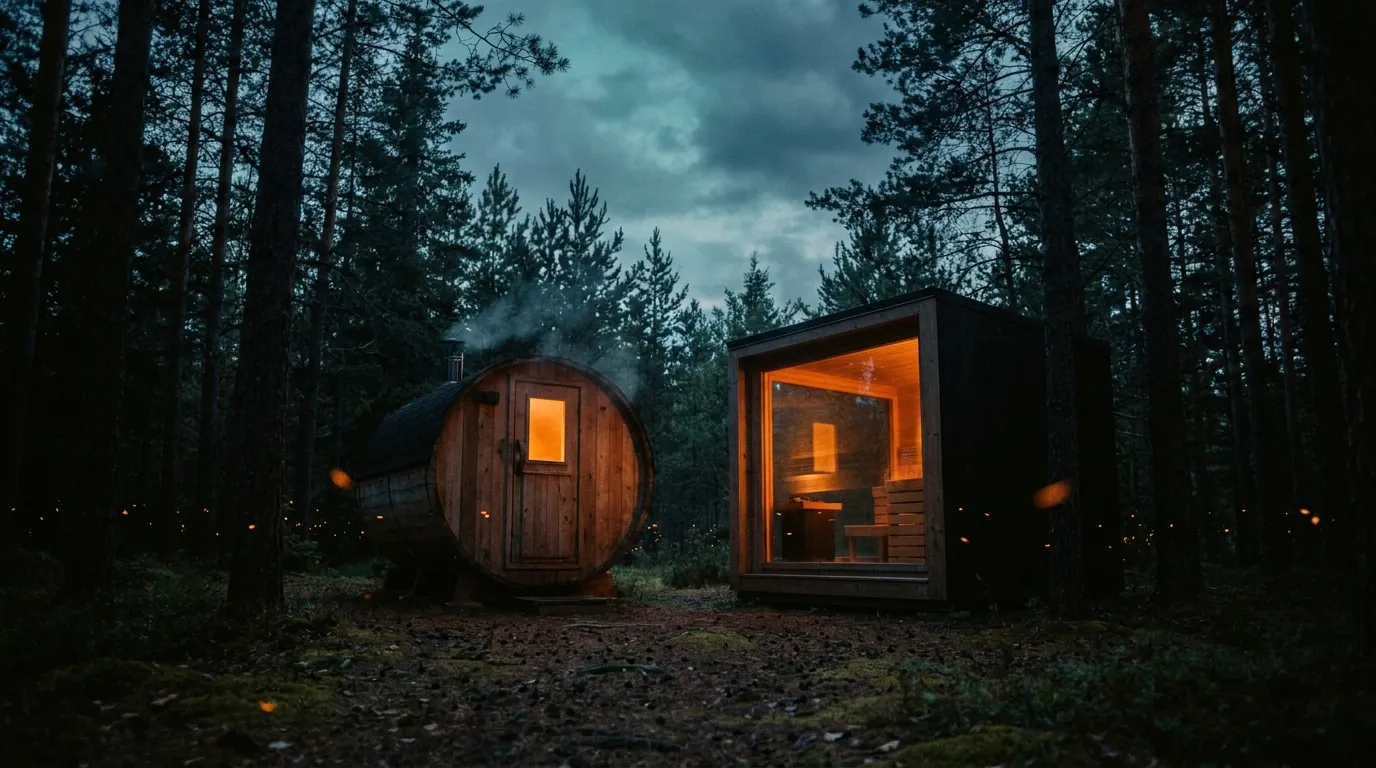
A heat-and-sweat ritual twenty steps from your back door, most nights of the week. That is what a barrel sauna actually sells: a daily habit for recovery, for winding down stress, and for the long-term heart health the sauna research keeps pointing to (Laukkanen et al., JAMA Internal Medicine, 2015), in the most affordable way to get a real sauna outdoors. Some links below are affiliate links, they never change what we recommend, see our disclosure.
The catch is the price, and it is not the one on the product page. What lands in your driveway and switches on costs more than the sticker, and that gap is where people overspend. So here is the honest version: how one is actually built and why it skips the foundation a cabin often needs, what it really costs delivered and wired, the wood choice that matters, how it stacks up against an insulated cabin, and then the parts a bare kit leaves out.
How a barrel sauna is actually built
Strip away the marketing and it is a simple structure: staves of solid wood, usually cedar cut 1.5 to 2 inches thick, pulled into a curve by steel bands the same way a wine barrel is built, the whole thing resting on a wooden cradle rather than bolted down. That cradle is the detail that changes the maths against a cabin. Because the barrel shape carries its own weight evenly across the cradle, a poured foundation is not strictly required, a bed of gravel or pavers underneath is usually enough. Size the heater to the air inside, not the outside dimensions: budget 1 kilowatt for every 45 to 50 cubic feet of interior volume, and add 20 percent to that if it is sited outdoors, which every barrel sauna is.
The delivered cost, not the sticker
Here is the breakdown brands leave off the page. The sticker is real, but freight and the 240V electrical for the heater are what turn a $4,500 barrel into a $5,500 to $7,000 project, even before you spend a cent on a foundation you likely do not need.
| What you pay for | Typical cost | Notes |
|---|---|---|
| Barrel unit (2 to 6 person) | $3,000 – 7,500 | the sticker price for the barrel itself |
| Freight & delivery | $200 – 500 | heavy palletised freight, curbside |
| Leveling pad (optional) | $0 – 300 | gravel or pavers under the cradle, not a foundation |
| 240V electrical | $500 – 3,000 | electrician + dedicated circuit for the heater |
| Accessories | $100 – 300 | cover, bucket & ladle, thermometer, extra stones |
| Delivered total | ~$3,800 – 11,600 | the real all-in figure |
Freight and electrical ranges are typical US market and contractor figures, not maker quotes, your site conditions change them. The electrical is the big variable: an easy run near the panel is cheap, a long outdoor trench is not. Work your own running cost in the cost-to-run calculator.
The wood question
Two choices cover almost every barrel worth buying, and our best wood for a sauna guide sets them against the rest of the field:
- Western red cedar. The classic: aromatic, naturally rot-resistant, light and stable, cut 1.5 to 2 inches thick for the staves. It looks and smells like a sauna should, but it costs more and wants occasional treatment to keep its color.
- Thermally modified spruce (sometimes hemlock). Kiln-treated so it resists warping, swelling and rot better than raw timber, which matters in a wet climate. You lose some of the cedar scent and pale color, and gain shape stability. It is often the smarter outdoor buy.
Assembly, and the groundwork nobody mentions
Most barrels ship as a kit you assemble, and a weekend with a helper is usually enough, the staves and steel bands go together without special tools. Paying extra for professional assembly is worth it only if you cannot manoeuvre a heavy pallet or want it perfect first time. Either way, sort three things before delivery.
- A level cradle. A barrel needs firm, level ground under the cradle, a bed of gravel or pavers on a patio or in the backyard is enough, no poured slab required. Set it on uneven grass and it settles, and the door starts to bind.
- The heater choice. Most buyers take an electric heater, which is where the 240V circuit and electrician come in. Many barrels also offer a wood-burning stove, which needs no electrics and suits off-grid or cabin use, at the cost of tending a fire and running a flue through the roof.
- Ventilation and year-round use. A barrel wants a small air gap for ventilation, and it is built to be used year-round outdoors, the round shape sheds snow and rain well rather than pooling on a flat roof. Putting one indoors is possible but rarely worth the ventilation and clearance headache, these are made for outside.

Wood-fired vs electric barrel sauna
Every barrel sauna we review here runs on an electric heater, plugged into the 240V circuit above, because that is what most US backyards can actually support day to day: press a button, hit temperature in under an hour, done. A true wood-fired barrel sauna is a different animal and a different ritual, you split or buy logs, tend the firebox, and wait closer to ninety minutes for the stones to come up to heat. Some buyers want exactly that, the fire itself is part of the wind-down. What it costs you: most municipalities treat a wood-burning stove as a solid-fuel appliance, so check local permit rules and clearance-to-structure distances before you site one, and the chimney needs a spark arrestor. Off-grid or cabin sites where 240V is not an option are where wood-fired earns its keep; anywhere with power already run to the yard, electric is the simpler buy and the one we stock.
Barrel vs insulated cabin, the trade-off nobody spells out
Round shape, no wall insulation, no foundation. Here is where that actually lands against a boxier, insulated cabin.
| Barrel sauna | Insulated cabin | |
|---|---|---|
| Insulation | Single-layer cedar staves, 1.5 to 2 in thick, no wall insulation | Insulated double-wall panels hold the heat in |
| Heat-up time | About 45 to 60 min to temperature, then heat leaks past the shell | About 30 to 45 min, and it holds once you get there |
| Snow handling | Curved roof sheds snow and rain on its own | Flat or pitched roof, usually needs clearing in heavy snow |
| Price band | $3,000 – 7,500 | $2,500 – 15,000+ |
| Foundation requirement | Sits on a cradle on gravel or pavers, no poured foundation required | Usually a level pad or deck, some models call for a permanent foundation |
| Best climate fit | Mild to cold climates, someone tending the heater each session | Cold, snowy or windy sites where retained heat and lower running cost matter most |
Add it up and the trade-off is plain. Skipping the foundation genuinely saves money and a weekend of groundwork, a barrel's curved roof sheds snow and rain that would sit and rot flat lumber, and freight lands around $200 to $500 either way, so that number is not what should decide barrel versus cabin. What decides it is the wall. No dead-air gap in a single-layer stave shell means the barrel loses heat fast once the heater is off, and in a genuinely cold or windy site that shows up as a higher power bill every single session, not a one-off cost. Thermally modified spruce closes some of that gap versus cedar on durability, but it does not add insulation. If your climate is mild, or you are happy running the heater a little longer for the ritual, the barrel earns its lower price and easier siting. If you are in snow country chasing the cheapest long-term running cost, price it against an insulated cabin before you buy.
Common questions
What does a barrel sauna really cost?
Sticker $3,000 to $7,500, but delivered $3,800 to $11,600 once you add freight and the 240V electrical. No foundation cost to add, unlike some insulated cabins.
Does it need a foundation?
No, not a poured one. It sits on a cradle that just needs a level, firm surface, gravel or pavers work. It cannot skip level though, an uneven cradle lets the staves gap as the barrel settles.
Cedar or thermally modified spruce?
Cedar for the look and scent; thermally modified spruce for shape stability in wet climates. Both last well with care.
Do they heat evenly?
No, they run hot at the head and cool at the feet, and with no wall insulation cost more to run than an insulated cabin. That is the price of the shape. Compare cabins.
How long does a barrel sauna last?
15 to 25 years with basic care: reseal the exterior every 2 to 4 years and keep the cradle dry and level. Expect to replace heating elements around year 10 to 15. The full care routine.
The parts a bare kit leaves out
Two things worth sorting before delivery day: the heater and the finish.

DROP Series Sauna Heater Package
A complete sauna heater package with stones and controls, the part a bare barrel kit often leaves you to source separately.
from $2,716 · $2,716–$3,395 across 8 options, choose on the product page
Confirm stock and lead time with the retailer. Price is for the unit and excludes delivery.

Ultra-Low VOC Sauna Stain
Ultra-low-VOC stain to seal the staves, the maintenance a barrel needs to avoid leaks and rot.
from $75 · $75–$199 across 4 options, choose on the product page
Confirm stock and lead time with the retailer. Price is for the unit and excludes delivery.
Sources & method
Evidence cited above: Laukkanen et al., cardiovascular mortality vs sauna frequency, JAMA Internal Medicine, 2015 (PMID 25705824).
Unit prices reflect current maker pricing for the barrel saunas we review (see best barrel saunas), July 2026. Freight and electrical ranges are typical US market and contractor planning estimates, not maker quotes, and vary with your site. This is a buying guide, not medical advice, the cardiovascular finding above is an association from observational data, not a treatment claim.