The honest guide to putting a sauna inside your house
Some links below are affiliate links, they never change our picks. Disclosure.
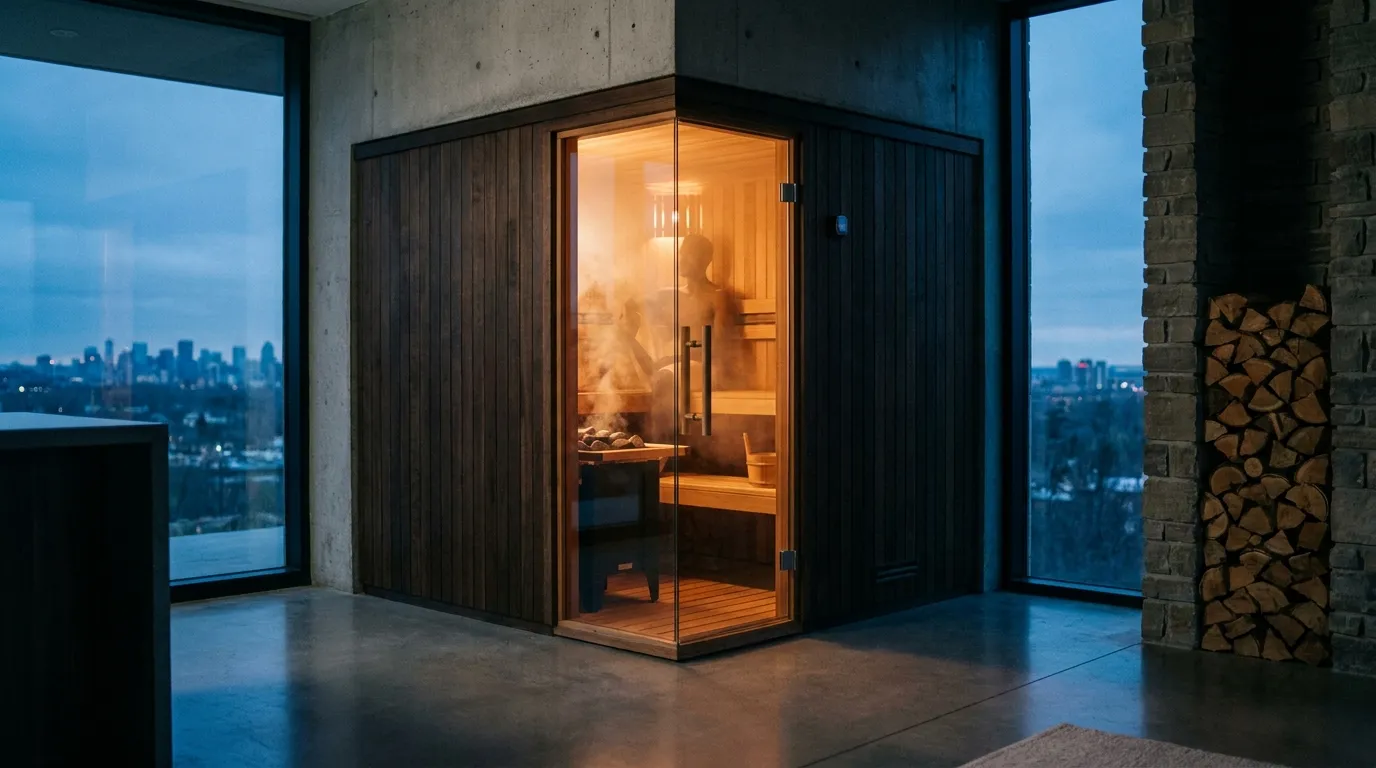
Not everyone has a backyard, or wants a build crew in it. If you're in a condo, a rented house, or a place where an outdoor cabin just isn't happening, the habit you're actually chasing, the sweat, the wind-down, the cardiovascular case a 20-year Finnish cohort keeps making for frequent use (a 63% lower rate of sudden cardiac death among the most frequent sauna users, Laukkanen et al., JAMA Internal Medicine, 2015), doesn't have to live outdoors. An indoor sauna for home use can sit in a spare room, a basement corner or a garage bay. The honest catch most listings skip: not every house can take one without real thought about floor load, moisture and power. Below is the pre-purchase checklist, then the three real indoor routes, ranked by what actually fits inside a house rather than a backyard.
The short answer. Simplest indoor install, no electrician: an infrared cabin on a normal outlet. Want the real steam-and-rocks heat indoors at the lowest entry price: the Sweat Kingdom Sweat Box, $5,545. Building it into the room properly, sized to your space: a custom cabin from $17,995.
Is an indoor sauna worth it?
For most people who'll actually use it, yes. The honest math: a Sweat Box at $5,545 or a custom cabin from $17,995 is a real number up front, but it's a purchase you make once and run for cents a session for a decade, against a studio heat session that runs $30 to $60 a visit and never becomes yours. Think of it as the recovery half of a gym built into your own house, no drive, no class schedule, no bill that keeps running after you stop showing up. The catch isn't the sauna, it's the same catch as a home gym: if it sits in a spare room you forget about, it's a bad purchase at any price. If it's on your daily path, the math and the habit both work in your favor.
What will 20 minutes in a sauna actually do?
One session is not a health intervention, it's the start of a habit. In the 15 to 20 minutes most people sit for, your heart rate climbs, you start sweating within a few minutes, and the heat reaches muscle in a way a hot shower doesn't; step out and most people feel a fast, clear drop into calm as your body cools back down. What the research actually supports isn't one session, it's the cumulative effect of doing this several times a week for years. The 20-year Finnish cohort behind the cardiac numbers above followed men doing 4 to 7 sessions a week, not one (Laukkanen et al., JAMA Internal Medicine, 2015). So the honest answer is: a good sweat and a real wind-down tonight, and a real cardiovascular case only if you keep doing it for years, not from tonight alone.
Can your house actually take one? The pre-purchase checklist
This is the part almost every "best indoor sauna" list skips, because it's not about the sauna, it's about your house. Four things to check before you spend a dollar.
| Check | Why it matters | What to do |
|---|---|---|
| Floor load | A traditional cabin with rock and a full heater can weigh 700 to 1,200+ lb loaded, that is fine on a slab or a well-supported basement floor, and a real question on a second-story or older joisted floor. | Confirm the unit weight against your floor, ask a contractor if it is a second floor or an older structure. |
| Ventilation & moisture | A sauna dumps heat and, with a traditional heater, steam into the room around it. Indoors, that moisture needs somewhere to go or it condenses in drywall, insulation and framing over time. | A dedicated inlet/outlet vent pair for the cabin, plus a bathroom-grade exhaust fan or dehumidifier for the room it sits in. |
| Ceiling height | Most cabins want 78 to 84 in of clear ceiling height for the unit plus the vent gap above it, a low basement ceiling can rule out a cabin before price even matters. | Measure floor to the lowest duct, joist or pipe in the actual spot, not the room’s nominal height. |
| Power: 120V infrared vs 240V traditional | Most infrared cabins plug into a standard 120V/20A outlet, no electrician required. A traditional heater over about 4.5 kW needs a dedicated 240V circuit run from your panel. | Check your panel has spare capacity before you commit to traditional, or budget $500 to $3,000 for the electrician if it does not. |
These are the checks that decide whether an indoor install is straightforward or needs a contractor and an electrician first, they are not brand-specific and apply to any cabin you're considering.
Does an indoor sauna actually heat up the room around it?
A little, and it depends on the type. A traditional cabin heats itself to 150 to 195°F inside, and every time the door opens, or water hits the rocks, some of that heat and humidity escapes into the room around it, which is exactly why the ventilation row above matters, a bathroom-grade exhaust fan or a dehumidifier clears it before it becomes a moisture problem. An infrared cabin runs cooler, 120 to 150°F, and warms your body directly rather than heating a volume of air, so it leaks far less heat and almost no humidity into the surrounding room, one reason it's the easier fit for a bedroom or a small nook. Either way the room does warm up a little during and just after a session; what you're actually managing isn't the heat, it's the moisture that comes with it in a traditional cabin.
The three real indoor routes
Once the checklist above says yes, there are three genuinely different ways to put a sauna inside a house, and they suit different buyers.
1. Prefab infrared, the no-electrician route
Almost every dedicated infrared cabin, one or two-person, plugs into a standard 120V/20A outlet. No dedicated 240V circuit, minimal moisture (infrared warms you directly rather than steaming the room), and the smallest footprint of the three routes, which makes it the easiest fit for a spare bedroom, a closet-sized nook or an apartment. It's also the cheapest way in. We rank the full field, including which brands actually publish a lab-tested EMF figure, in best infrared saunas, and the tightest indoor footprints specifically in best 2-person saunas. Of that field, one cabin is on a live merchant feed we can price and link, so it is the one we can show you here rather than describe.
Peak Crown (2 Person)
Cheapest way into the no-electrician routePrice is for the unit and excludes delivery.
- Capacity
- 2-person
- Footprint
- 48 x 44 in exterior, 79 in tall, 385 lb
- Power
- 120V standard outlet, no electrician (brand-stated)
- Red light
- Ceiling-mounted medical-grade panel, included
Buy it if, you want the infrared route done for the least money, in a cabin that seats two and needs nothing done to the room but a free socket.
Watch out, Peak puts the Crown’s red-light panel in the ceiling, which its own copy for its dearer cabins calls the wrong place for it, and it publishes no EMF figure for this model. If EMF evidence is the deciding factor, the brands that name a test lab are on the infrared page.
2. Prefab traditional, one real cabin at a low price
If infrared's gentler heat isn't what you're after and you want the actual steam-and-rocks ritual indoors, without paying custom-build money, Sweat Kingdom's Sweat Box is the honest entry point: a genuine one-person traditional cabin built to sit inside a house rather than a yard. It's the smallest real wood sauna in their range, which is a feature, not a compromise, most solo users overbuy on capacity.
Sweat Kingdom Sweat Box (1 Person)
Best prefab traditional
Made to order, ships in ~5 weeks. Price is for the unit and excludes delivery.
- Capacity
- 1-person
- Wood
- Cedar (Sweat Kingdom’s standard build)
- Power
- Traditional heaters this size typically want a 240V circuit, confirm the exact spec on the listing
- Warranty
- See listing
Buy it if, you want real steam-and-rocks heat indoors without a custom build, and one person most sessions is honestly the capacity you need.
Watch out, budget for an electrician if a 240V circuit isn't already in the room, and it's a prefab footprint, not sized to your exact space.
3. Custom build, sized to your actual room
A custom cabin is built to your dimensions rather than a stock footprint, which is the answer once you know your ceiling height, your floor plan and your power all differ from what a prefab assumes. Sweat Kingdom's SK 110 is the entry tier of their custom line, from $17,995 across footprint and capacity options, plus a heater package and, if you want it done right the first time, professional installation. This is the tier where the checklist above stops being optional; a custom cedar cabin at this weight and power draw is exactly the install that wants a real floor-load and electrical check before it's ordered.

SK 110
Custom cedar cabin, built to your footprint and capacity rather than a stock size. The entry tier of Sweat Kingdom's custom line.
from $17,995 · $17,995–$31,200 across 27 options, choose on the product page
Confirm stock and lead time with the retailer. Price is for the unit and excludes delivery.

KIP Series Sauna WiFi Heater Package, Stainless Steel
A WiFi-controlled heater package sized to add to a custom or existing cabin.
from $2,276 · $2,276–$2,387 across 3 options, choose on the product page
Confirm stock and lead time with the retailer. Price is for the unit and excludes delivery.

Professional Assembly
Professional installation, the line a custom indoor build shouldn't skip.
$1,500
Confirm stock and lead time with the retailer. Price is for the unit and excludes delivery.
The Kip above is one heater tier, if your custom footprint needs more power or a different control style, compare the full range in best sauna heaters.
Indoor infrared vs indoor traditional, the quick decision
Both routes above put a sauna indoors, the real split between them is heat style, power and running cost, not one being "better." Infrared runs cooler, 120 to 150°F, plugs into a standard 120V outlet, warms up in 10 to 15 minutes and costs $0.12 to $0.18 a session to run. Traditional runs hotter, 150 to 195°F, wants a dedicated 240V circuit and an electric sauna heater doing the actual work, with warm-up nearer 30 to 45 minutes, at $0.90 to $1.40 a session. If your priority is the easiest indoor install and the lowest bill, take infrared, see the best infrared saunas. If it's the real steam-and-rocks ritual and you're fine budgeting for the circuit, take the Sweat Box or a custom build above, both built around an electric sauna heater sized to the cabin. The full side by side, including which has the stronger health evidence, is in our infrared vs traditional sauna guide.
Basement and garage specifics
A basement sauna is the most common indoor install, and the most forgiving on floor load, a slab or well-supported basement floor handles the weight without the second-story questions above. The real basement issue is moisture on top of moisture: basements already run humid, and a sauna adds more, so a dehumidifier or a dedicated exhaust fan for the room isn't optional, it's what keeps the drywall and any nearby framing from taking on damage over a year of regular use. Keep the cabin a few inches off any wall so air actually circulates behind it, and check the ceiling height against ducts and pipes, not just the room's nominal height, low basement ceilings are the single most common reason a basement sauna plan gets shelved.
A garage is usually the easier power story, if a 240V outlet or a subpanel is already there for tools, a traditional heater is a much shorter electrical job. The trade-off is temperature swing, an unconditioned garage in winter makes the heater work harder and slows warm-up, and in summer it can already be warm before you turn anything on. Either way, garage or basement, the four checklist items above apply exactly the same, an indoor sauna doesn't get a pass on floor load or ventilation just because it's not in a bedroom.
Cost stack: indoor vs outdoor
Going indoors doesn't just change where you sweat, it changes what you pay beyond the sticker price. Outdoor cabins need a base or pad and often a longer electrical run from the panel; indoors, a lot of that disappears, but ventilation work replaces it.
| Line item | Indoor | Outdoor |
|---|---|---|
| Base / groundwork | Usually none, existing floor | $200–800 for a level pad |
| Electrical (240V traditional) | $500–2,000, shorter panel run | $700–3,500, trenching outdoors |
| Ventilation / moisture control | $150–600, fan or dehumidifier | Minimal, open air handles it |
| Running cost (infrared, per session) | $0.12–0.18 | Same, if infrared |
Figures are typical US planning estimates, not maker quotes, and vary with your site and rate. Run your own electricity numbers in the cost-to-run calculator; the full all-in breakdown by sauna type is in our home sauna cost guide.
What I'd tell a client about placement
The detail that decides whether an indoor sauna gets used is where you put it, not which one you buy. A cabin in a finished basement you have to make a trip down to gets used on weekends. The same cabin in the spare room you walk past every night, on the way to bed, gets used on a Tuesday. That's not a design opinion, it's habit psychology: the sauna you see gets used, the one you have to plan a visit to becomes a once-a-month thing you feel vaguely guilty about. If floor load, moisture and power all check out in more than one spot in your house, pick the one on your daily path, not the one with the most square footage.
Common questions
Does an indoor sauna need special ventilation?
Yes, the cabin needs its own inlet and outlet vents, and the room around it needs a way to clear escaping humidity, usually a bathroom-grade exhaust fan or a dehumidifier. Skipping this is the most common indoor-install regret.
Will it cause moisture damage to my house?
It can if the room has nowhere for the humidity to go. The cabin itself has a vapor barrier; the risk is the surrounding drywall and framing over months of use. A vented room, a dehumidifier, and keeping the cabin off the wall solves this for almost everyone.
Do I need an electrician?
Not for a 120V infrared cabin, it plugs in like a large appliance. For a traditional heater over about 4.5 kW, yes, a dedicated 240V circuit needs an electrician, commonly $500 to $3,000 depending on the run from your panel.
Is an indoor sauna worth it?
For most people who'll actually use it, yes. A Sweat Box at $5,545 or a custom cabin from $17,995 is a real cost up front, but it runs for cents a session for a decade, against a studio visit that costs $30 to $60 and never becomes yours. It stops being worth it only if it sits somewhere you won't walk past.
What type of sauna is best for a home install?
For the easiest indoor install, infrared, it plugs into a standard 120V outlet and needs no electrician. For the real steam-and-rocks ritual indoors, a prefab traditional cabin like the Sweat Box, or a custom build sized to your room if a stock footprint doesn't fit. There's no single best type, it depends on your power, your ceiling height and which experience you actually want.
What will 20 minutes in a sauna actually do?
One 20-minute session gives you a real sweat, an elevated heart rate, and for most people a fast drop into calm once you cool down, it's not a health intervention on its own. The cardiovascular case in the research above comes from doing this 4 to 7 times a week for years, not from a single session.
Does an indoor sauna heat up the room around it?
A little. A traditional cabin leaks some heat and humidity into the room every time the door opens, which is why ventilation matters. An infrared cabin runs cooler and warms your body rather than a volume of air, so it leaks far less heat and almost no humidity into the room around it.
Sources & method
Product specs and prices come from Sweat Kingdom's own listings, current July 2026, use the retailer links above for live pricing, which changes often. Floor load, ventilation and electrical guidance reflect typical US residential requirements for cabins in this weight and power class, not a specific engineer's assessment of your home, always confirm floor load and circuit capacity with a qualified contractor or electrician before ordering. The cardiovascular figure is from the peer-reviewed Finnish cohort study cited above (Laukkanen et al., JAMA Internal Medicine, 2015); it is an association from regular sauna use generally, not a claim specific to any indoor product. Cost-stack figures are planning estimates, use the cost-to-run calculator with your own rate.