Infrared vs traditional sauna, decided on what actually differs
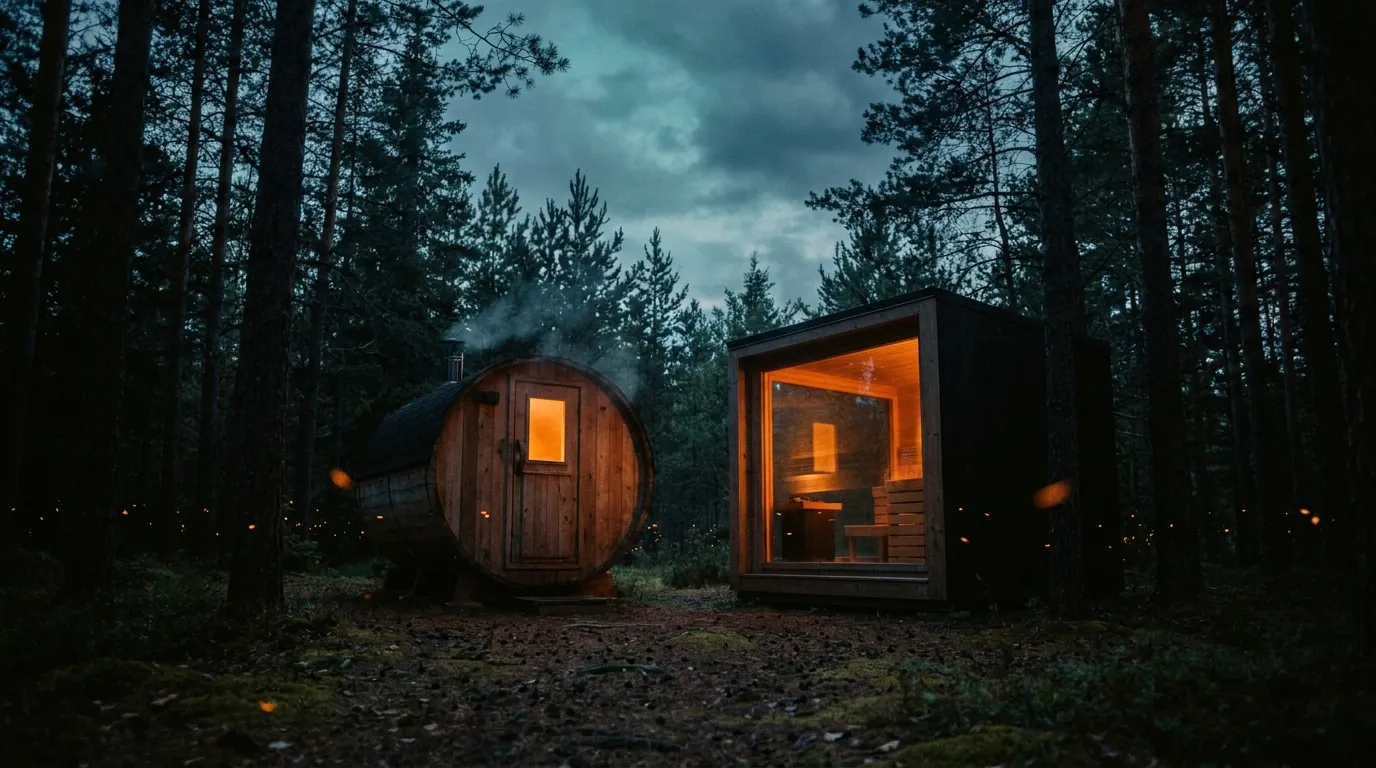
Most people choosing between infrared and traditional are really after the same thing: the health benefits. The recovery after training, the stress that lifts in the heat, the sweat, the long-term cardiovascular payoff a 20.7 year Finnish cohort keeps pointing to (Laukkanen et al., JAMA Internal Medicine, 2015). So the honest question is not which is "better," it is which type actually delivers the benefits you care about, and what each costs to live with. Infrared warms your body directly and gently and runs cheap; traditional heats the air hotter, gives you steam, and carries the stronger evidence. Here is the real comparison, heat, cost, and health, side by side, so you buy the one that fits your body and your budget. Some links below are affiliate links, they never change what I recommend, see our disclosure.
The heat, side by side
Seven numbers settle most of the argument, including the one comparisons usually skip: how much evidence actually backs each one.
| Infrared | Traditional | |
|---|---|---|
| Air temperature | 120–150°F | 150–195°F |
| Humidity | Ambient | 10–20% |
| Session length | Comfortably 30 min | 10–15 min |
| Heater power | 1.5–1.7kW | 5–8kW |
| Cost per session | $0.12–$0.18 | $0.90–$1.40 |
| Install voltage | Often a standard 120V plug | 240V dedicated circuit |
| Evidence weight | Thinner: smaller, newer studies, not yet equal weight | Strongest: 20.7 year Finnish cohort (PMID 25705824) |
What it actually costs to run
The power draw is where the two setups diverge hardest. A traditional heater holds a 5 to 8kW draw for the whole 10 to 15 minute session, roughly $0.90 to $1.40 a sitting at the US average residential rate. An infrared cabin needs only 1.5 to 1.7kW, so even a longer 30 minute sit costs about $0.12 to $0.18. Plug in your own rate and habits below for the real number.
US residential average is ~$0.19/kWh, change it to your rate for a real number.
Chiller cost is driven by cooldown and standby across the day, not your minutes in the water, so plunging more often barely moves the bill.
Estimate based on typical power draw and your inputs. Real cost varies with insulation, ambient temperature, and standby behavior.
Which one is for you
- Buy infrared if you want low running cost, a unit that plugs into a normal outlet, and a gentler heat you can sit in for a full 30 minutes. It suits most indoor, everyday setups. See the best infrared saunas.
- Buy traditional if you want the real thing: higher heat, the smell of hot cedar, and löyly steam from water on the rocks, backed by the deepest sauna evidence there is. Accept the 240V circuit and the higher bill as the price of the ritual. See the barrel and cabin saunas.
A common mistake is buying on "better" when the honest answer is "different." If in doubt, most first-time buyers who want the authentic sauna feel go traditional; those who prioritise convenience and running cost, or who will use it daily, go infrared.
Does infrared give the same health benefits?
This is the question most comparisons dodge, so here is the honest version. The strongest evidence for sauna and health comes from traditional Finnish saunas, not infrared.
Infrared saunas are far less studied. Because they run cooler and warm you with infrared light rather than heating the air, it is an open question whether they deliver the same cardiovascular effect, and the small trials that exist are promising but genuinely thinner and newer, not equal weight to the traditional data. So the fair position is this: traditional has the better research, infrared has the convenience and the lower running cost, and anyone claiming infrared simply matches the traditional heart-health data is going past what the studies show. None of this is medical advice.
Two myths worth clearing. Infrared saunas do not produce steam, so there is no löyly, the water-on-the-rocks ritual belongs to traditional saunas only. And you do not have to pick one forever. Plenty of people run an infrared cabin on weekdays for convenience and use a traditional sauna for the full experience, or pair either with a cold plunge for contrast therapy.

How sauna heat affects the body
Both types work on the same basic physiology, worth understanding before you choose. Heat raises your core temperature, your blood vessels widen, and your heart rate climbs, in a hot traditional sauna often to 100 to 150 beats a minute, a load on the cardiovascular system comparable to moderate exercise. That repeated mild stress is the leading explanation for why regular sauna bathing tracks with better heart health and the reduced cardiovascular risk seen in the Finnish cohort data (Laukkanen et al., 2015). Heat also relaxes muscles and eases joint and muscle pain for many people. Infrared reaches a lower air temperature but still lifts core temperature and heart rate, just more gently, part of why it is easier to sit in for 30 minutes but less studied for the cardiovascular endpoints. Anyone with a heart condition, or who is pregnant, should check with a doctor first; none of this is medical advice.
The downsides of each
No comparison is honest without the drawbacks.
Infrared downsides. No steam and no löyly, so if the smell of hot cedar and a burst of humidity is the ritual you want, infrared will disappoint. The cardiovascular evidence is thinner and newer than for traditional. And because the heaters sit close to your skin, low-EMF panel quality matters, cheaper units can read higher on electromagnetic fields, so buy a brand that publishes low-EMF figures.
Traditional downsides. The 240V circuit and electrician, commonly $800 to $2,500, plus the higher $0.90 to $1.40 running cost, five to nine times infrared's. The heat is intense, which is the point, but it means shorter 10 to 15 minute sessions and a real need to hydrate, dehydration and lightheadedness are the usual ways people overdo a hot sauna. Neither type is dangerous used sensibly; both reward starting short and building up.
Price and construction
The build explains the price. An infrared sauna is a lightweight cabin lined with carbon or ceramic far infrared panels and wired for a 120V plug, which is why it is cheaper to buy, quicker to install and cheaper to run at 1.5 to 1.7kW. A traditional sauna is heavier: insulated or barrel-shell timber, a 5 to 8kW rock heater, and a 240V feed, built to take being repeatedly soaked with löyly steam and taken to 190°F. That heavier build and the electrical are most of the price gap, and most of the reason the traditional sauna carries the stronger health data, it simply gets hotter and works the body harder.
The traditional side of this comparison
If you land on traditional after weighing it up, here's a real one, in stock.

The Sweat Cabin (4 Person)
A traditional insulated cedar cabin, the authentic side of this comparison. The steam and rocks come from a heater chosen at checkout, which the from-price does not include.
from $6,495 · $6,495–$9,995 across 8 options, choose on the product page
Made to order, 5-week lead time stated by the retailer. Price is for the unit and excludes delivery.
Common questions
Is infrared or traditional better?
Different, not better. Infrared is gentler, cheap to run and plugs in; traditional is hotter, gives you steam, needs 240V, and has the stronger evidence. Convenience versus ritual.
Which costs less to run?
Infrared, by a lot, roughly $0.12 to $0.18 a session versus $0.90 to $1.40 for traditional, five to nine times more. Calculate yours.
Does infrared need 240V?
Usually no, most infrared cabins run on a 120V plug. Traditional almost always needs a 240V circuit and an electrician.
What's the downside of infrared?
No steam or löyly, thinner and newer cardiovascular evidence than traditional, and low-EMF panel quality matters since the heaters sit close to your skin. Buy a brand that publishes its EMF figures.
Which is healthiest?
Traditional has the strongest research, mostly on heart health, because that is what the long studies used. But the healthiest sauna is the one you will actually use, frequency matters more than type. Not medical advice.
Sources & method
Evidence cited above: Laukkanen et al., JAMA Internal Medicine, 2015, a 20.7 year Finnish cohort of 2,315 men (PMID 25705824).
Temperature, humidity, session and power figures are typical of the infrared and traditional saunas we review, July 2026. Cost-per-session and electrician figures are US planning estimates from unit power and the national average electricity rate, not maker or contractor quotes, your own rate changes them. The health evidence cited above comes entirely from traditional sauna research; nothing here is medical advice. Dry air relative humidity of 10 to 20 percent is the figure published for traditional saunas running 80 to 100°C (176 to 212°F) by Hussain and Cohen, Evid Based Complement Alternat Med 2018 (PMID 29849692), and by the National Collaborating Centre for Environmental Health, January 2026. Below that temperature, and any time water goes on the rocks, it runs higher: the North American Sauna Society puts typical practice at 20 to 40 percent. US residential code caps a sauna thermostat at 194°F (90°C) measured at the ceiling (IRC M1902.4), and manufacturers’ controllers top out at the same number, so a bather level range and a ceiling level cap are two different figures.