Sauna vs steam room, decided on what fits your home
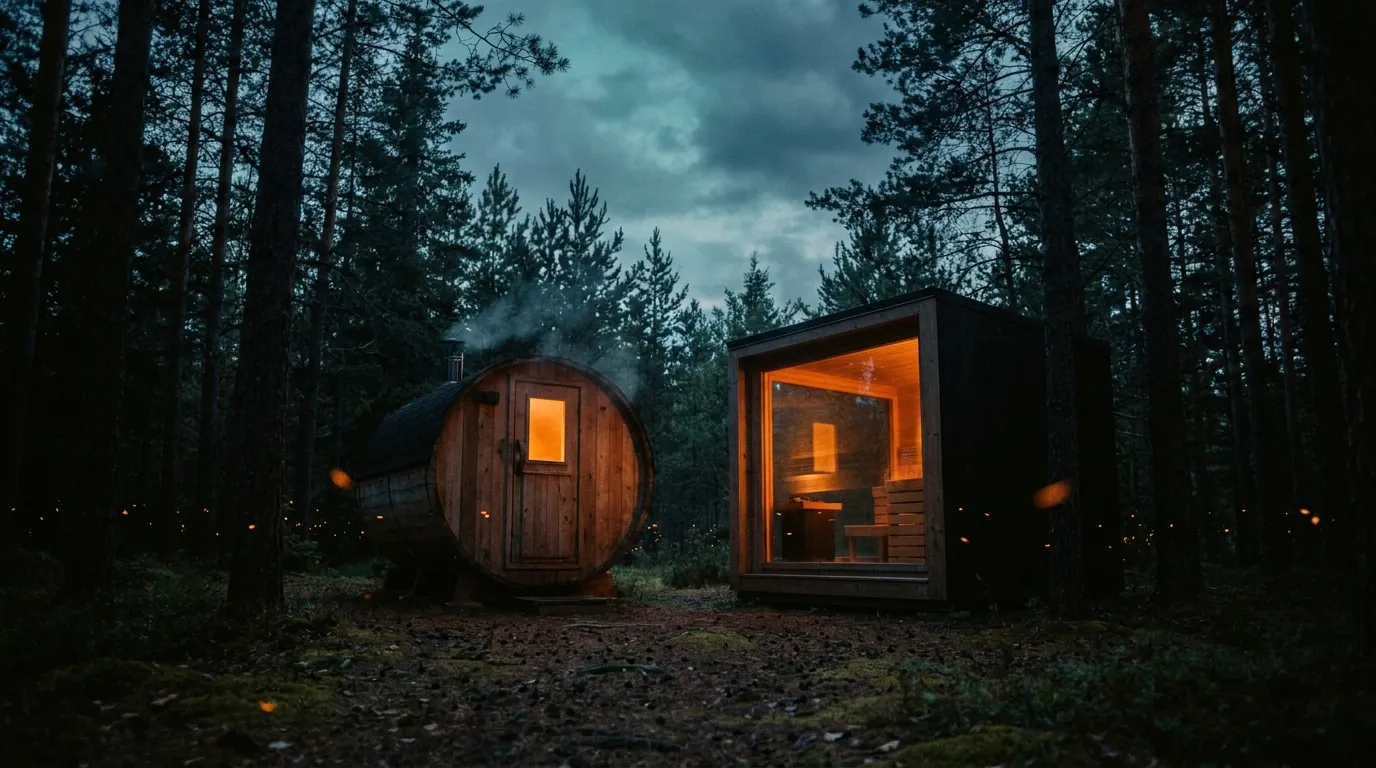
Sauna vs steam room is really two questions people run together. Which one feels better, and which one can you actually put in your home. As a wellbeing professional who has spent his career on health, stress and recovery, I'll tell you the second question usually decides it: a steam room is a plumbed, waterproofed, sloped-drain construction project, and a sauna is a cabin that gets delivered and wired. It also carries the stronger long-term evidence, a 20.7 year Finnish cohort tied frequent sauna use to markedly lower cardiovascular death and dementia risk (Laukkanen et al., JAMA Internal Medicine, 2015). Here is the honest comparison on temperature, humidity, real install cost, mold and upkeep, and the evidence gap most roundups skip, plus a middle option most buyers never hear about. This site earns a commission if you buy through a link below, at no extra cost to you.
Side by side, on what actually differs
Temperature and humidity are the headline difference, but they are not the one that decides most purchases. Install cost, upkeep and the evidence behind each one matter just as much once you actually own it.
| Sauna | Steam room | |
|---|---|---|
| Temperature | 150–195°F, dry heat | 110–120°F, but reads far hotter |
| Humidity | 10–20% (dry, or a löyly burst) | ~100% (saturated) |
| Home install cost | $2,299–$6,000, delivered cabin | $5,000–$15,000+, plumbed construction |
| Running cost | $0.90–1.40 per session, electric only | Similar power draw, plus a ventilation/dehumidification load after every session |
| Maintenance burden | Wipe down cedar; low mold risk in dry heat | Mold and mildew management, drain slope upkeep, run the fan after every use |
| Evidence strength | Strong: 20+ year Finnish cohort data on cardiovascular death and dementia risk | Thin: no equivalent cohort data; detox and congestion claims are unverified |
| Best for | Cardiovascular and longevity evidence, fast install, renters | Buyers set on saturated heat who accept the construction project and the upkeep |
How the heat actually works on your body
The humidity difference is not just comfort, it changes how your body copes with the heat. In a sauna's dry air, sweat evaporates off your skin, and that evaporation is what cools you and lets you tolerate 150 to 195°F for 10 to 20 minutes. In a steam room, the air is already saturated, so sweat cannot evaporate, it just sits on your skin. That is why 110 to 120°F feels so intense, your body's main cooling mechanism is switched off, and it is also why most people find they can manage a shorter session in a steam room, commonly 5 to 15 minutes, than in a hot dry sauna. Both raise core temperature and heart rate in a way that mimics mild to moderate exercise. Hydrate well before and after either, and build up session length gradually rather than starting at the top end.
The build reality nobody puts on the box
This is the part that decides most home purchases, and it rarely gets said plainly. A sauna, barrel, cabin or infrared, is a manufactured product. It arrives as panels or a pre-built shell, gets wired to a 120V or 240V circuit, and you are using it within a day or two of delivery. A steam room is not a product, it is a room. It needs a fully waterproofed and sloped floor to a drain, sealed walls and ceiling behind tile or a sealed acrylic surface, a steam generator plumbed to a water line, glass, and ventilation to manage the moisture afterward. Get the waterproofing or the slope wrong and you get mold and rot inside the wall, not a cosmetic problem, a structural one. That is why a steam room is a licensed-contractor project and a sauna is a weekend install.
What the install cost gap actually looks like
A pre-built sauna runs $2,299 to $6,000 all in, see our full home sauna cost breakdown. A home steam room, done properly, commonly runs $5,000 to $15,000 or more once you price the generator, plumbing, waterproofing, drainage and glass. The gap is not the equipment, a steam generator on its own is not expensive, it is the construction: waterproofing, tile and glass carry most of the bill.

Mold, mildew and the upkeep nobody puts on the brochure
A sauna's dry heat is a poor environment for mold: wipe down the cedar and it stays low maintenance for years, and our sauna cleaning and care guide sets out exactly what that wipe down involves. A steam room is the opposite, damp, warm surfaces are exactly what mold and mildew like. Get the vapor barrier, tile slope or drain wrong during the build and mold grows behind the tile where you cannot see it. Even built correctly, a steam room needs the ventilation fan run after every session to dry the space out, and more frequent cleaning than a wood sauna interior. It is also a fixed, plumbed feature you cannot take with you if you move.
The evidence gap, stated plainly
The evidence is not balanced between the two, and it is worth saying plainly rather than pretending they are equivalent. A large Finnish cohort, followed for 20.7 years, found frequent sauna use tracked with lower cardiovascular death and, in a separate analysis of the same cohort, markedly lower dementia risk.
Steam room-specific research is thin by comparison. Claims made for steam, easier breathing, looser congestion, softer skin, a detoxifying sweat, are widely repeated but I could not find a steam room-specific study backing any of them at the scale of the sauna cohorts. Graded honestly, side by side:
| Claim | Evidence grade | What the research actually says |
|---|---|---|
| Frequent sauna use tracks with lower cardiovascular death | A | 20.7 year Finnish cohort, 2,315 men, dose response: hazard ratio 0.37 for sudden cardiac death at 4 to 7 sessions a week versus once weekly. Observational, not proof of cause. PMID 25705824 |
| Frequent sauna use tracks with lower dementia risk | B | Same cohort, 204 dementia and 123 Alzheimer's cases: hazard ratio 0.34 for dementia and 0.35 for Alzheimer's disease at 4 to 7 sessions a week versus once weekly. Observational, same limitations. PMID 27932366 |
| Steam rooms detoxify the body through sweat or vapor | D | No steam room-specific study supports this. Sweat is mostly water and salt, not a meaningful detox route, in a sauna or a steam room. |
| Steam eases congestion and respiratory symptoms | D | Widely claimed and plausible on the mechanism, but no steam room cohort or trial data backs it up. Treat it as unverified, not evidence based. |
If cardiovascular and longevity evidence is what is driving your decision, that points toward a sauna. If short-term relaxation or a slower, wetter heat is what you are actually after, steam is a reasonable choice, just go in knowing the research base behind it is much lighter. None of this is medical advice; talk to a doctor if you have a heart condition or are pregnant before starting either.
The third option most buyers miss
Here is what I tell clients who ask for "the steam room feeling" on a home budget: you don't need a steam room to get steam. Pour water over the hot rocks and you get löyly, a humid burst that reads close to a steam room for a few minutes before the room dries back out. The mechanism, and how far it does and does not close the gap, is in our wet vs dry sauna guide. No steam generator, no plumbing, no waterproofed and sloped room behind tile. Just a bucket and a ladle in a sauna you already own. It is the single biggest reason most people who think they want a steam room end up happier and thousands of dollars ahead with a sauna instead, and the full treatment of running one room both ways is in our wet vs dry sauna guide.

The Sweat Cabin (4 Person)
The buyable answer: a traditional cabin, delivered rather than built. The from-price is the cabin without a heater, and the 240V circuit is your electrician, but once the rocks are hot you get the steam moment without a plumbed steam room.
from $6,495 · $6,495–$9,995 across 8 options, choose on the product page
Made to order, 5-week lead time stated by the retailer. Price is for the unit and excludes delivery.

KOLO Bucket and Ladle
The tool that turns any sauna into a löyly session.
$136
Confirm stock and lead time with the retailer. Price is for the unit and excludes delivery.
Who should pick which
- The evidence seeker. If you're buying for the cardiovascular and longevity case, choose sauna. That is where two decades of Finnish cohort data sits, both for heart death and for dementia risk, and steam has nothing equivalent behind it.
- The wet-heat seeker. If it's specifically the saturated heat you're after, a sauna used with löyly gets you most of the way there without a construction project. A dedicated steam room is only worth the build, and the mold upkeep, if you use it daily and have the budget done properly.
- The renter. A steam room is a permanent, plumbed fixture, not something you take with you or rip out easily. A sauna, barrel, cabin or infrared, can be disconnected and moved. If there's any chance you relocate, that alone settles it.
Common questions
Is a sauna or a steam room better?
Different, not better. Sauna is hot and dry (150 to 195°F, 10 to 20% humidity), steam room is cooler but saturated (110 to 120°F, near 100% humidity). Sauna has the stronger long-term health evidence and is far simpler to install.
Can you get a steam room feeling from a sauna?
Yes, pour water on the hot rocks for löyly, a burst of humid heat that reads close to a steam room for a few minutes, no plumbing or tiling required.
How much more does a steam room cost to install than a sauna?
A pre-built sauna runs $2,299 to $6,000 all in; a home steam room, done properly, commonly runs $5,000 to $15,000 or more once plumbing, waterproofing, drainage and glass are priced in.
Do steam rooms grow mold?
They can. A wrong vapor barrier, tile slope or drain lets mold and mildew grow behind the tile, and even a correct build needs the fan run after every session and more frequent cleaning than a sauna.
Does a steam room have the same health evidence as a sauna?
Not by the evidence available. Sauna has two decades of Finnish cohort data behind it, including lower cardiovascular death and lower dementia risk; steam room-specific research is much thinner, and claims like detox or congestion relief are unverified. Not medical advice.
Sources & method
Evidence cited above: Laukkanen et al., JAMA Internal Medicine, 2015, a 20.7 year Finnish cohort of 2,315 men (cardiovascular death) (PMID 25705824); Laukkanen et al., Age and Ageing, 2017, same cohort (dementia and Alzheimer’s risk) (PMID 27932366).
Temperature and humidity ranges are the accepted standards for sauna and steam room use. Cost figures are typical US planning estimates for pre-built saunas and home steam room construction, not maker or contractor quotes, and vary with your site; calculate running cost for your home in the cost-to-run calculator. Steam room-specific claims (detox, congestion relief) are not backed by an equivalent citation and are flagged as unverified above. Nothing on this page is medical advice.