Cold plunge for muscle recovery, the dose the evidence actually supports
You just finished a hard session and you want to feel less wrecked tomorrow, not in a vague sense, in a specific one: less sore, less flat, ready to train again. As a wellbeing professional who has spent his career helping organisations manage health, stress and recovery, here is the honest, cited answer, including the exact temperature and time a 2025 network meta-analysis of 55 randomized trials found actually works (Wang, Wang & Pan, Frontiers in Physiology, 2025, PMID 40078372). This article contains affiliate links; if you buy through one, we may earn a commission at no extra cost to you.
Not what you're after? This page is the recovery science and the optimal dose, how cold, how long, and for which outcome. If you want the broader athlete primer (should you ice bath at all, weight loss myths, general safety), see our ice bath benefits guide instead. Same tool, this page goes deeper on the numbers.
Does cold plunge help muscle recovery
The honest, bounded answer is yes, for two specific things: how sore you feel and how your neuromuscular system reads on power and strength tests, not for how fast tissue actually repairs. The 2025 network meta-analysis pooled 55 randomized controlled trials and found cold water immersion consistently lowers perceived muscle soreness (DOMS) and eases neuromuscular fatigue markers such as jump height and strength readiness after hard training. Critically, the effect size depended heavily on getting the temperature and duration right, dosing matters here the way it matters with a medication, not every cold dip delivers the same benefit.
It is worth being precise about what recovery means in this context. A cold plunge is not clearing metabolic waste faster or rebuilding muscle fibres on an accelerated timeline. What it changes is perceived soreness and measurable neuromuscular fatigue, both of which matter enormously if you are deciding whether to train hard again tomorrow, but neither of which is the same claim as "heals you faster."
How cold and how long for recovery, the dose that works
This is the part most cold plunge content gets vague on, and it is the actual information gain in the 2025 meta-analysis. The optimal dose splits by outcome, not one blanket recommendation:
For soreness (DOMS)
11 to 15°C, 10 to 15 min
52 to 59°F. The best-supported dose for feeling less beaten up the next day.
For neuromuscular fatigue
5 to 10°C, 10 to 15 min
41 to 50°F. Colder, for restoring power and strength test readiness.
Both doses run longer than the quick 2 to 5 minute dip a lot of athletes default to, and the neuromuscular dose runs colder too. If you have been doing short, moderate dips and wondering why the effect feels underwhelming, duration is the more likely gap, most people undershoot time before they undershoot temperature.
The recovery dose, visualized
Both sweet spots sit in the same duration band, 10 to 15 minutes, but at different temperatures. Outside these boxes, either too warm, too brief, or unnecessarily extreme, the evidence for extra benefit thins out fast.
Cold plunge for DOMS and muscle soreness
If soreness is your actual problem, a cold plunge has the strongest evidence of any recovery tool you can buy. A 2026 meta-analysis of 13 randomized trials compared cold water immersion directly against whole-body cryotherapy chambers, the pricier, drier alternative gyms and clinics often push. Cold water immersion beat cryotherapy for reducing DOMS at 24 hours after exercise, the window that matters most for deciding whether tomorrow's session happens (Liu & Ma, Medicine (Baltimore), 2026, PMID 41578562). By 48 hours the two were not significantly different, so the plunge's real edge is in that first day.
My advisory take: this is the finding that should reset how people compare recovery tools. A 90 second cryo chamber visit is convenient, but a properly dosed plunge, 10 to 15 minutes at the right temperature, currently has the better evidence for next-day soreness, and you own the tub.
When the sore part is one joint, not all of you
The dose above is a whole body protocol, and that is what the trials measured. Plenty of training weeks do not call for it. If one knee is angry after a long run, or one shoulder after a pressing session, a cold compression wrap puts the cold exactly where the problem is, in the room you are already in, for the price of a couple of studio visits. It is the cheapest honest way onto the cold side of recovery, and it is the one piece of kit that still gets used on the weeks you cannot face a full plunge.
What it is not: a substitute for the immersion protocol above. The DOMS evidence on this page comes from whole body cold water immersion, so do not read the trial numbers as though they apply to a wrap on one joint. Targeted cold is for a specific sore spot, immersion is for a training block.
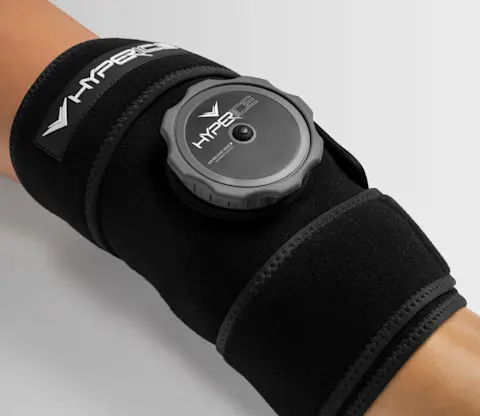
Hyperice Knee Ice Compression Wrap
The cheapest way in, ice and compression strapped to one knee rather than the whole body.
$90
Check current stock with the retailer. Price is for the unit and excludes delivery. This merchant's feed last updated in May 2026, so treat the price as that date rather than today's.
The hypertrophy trade-off
Roberts et al. (Journal of Physiology, 2015, PMID 26174323) found that cold water immersion straight after strength training attenuates the acute anabolic signalling in muscle, and over a training block, blunts the long-term strength and hypertrophy adaptations you are actually training for. This is the trade-off the recovery dose above does not solve, it makes soreness and neuromuscular fatigue better while working against size and strength gains if timed wrong.
The timing rule. Do not run the recovery dose in the hours right after a session where size or strength is the point. Move it to a separate day, do it before training instead of after, or reserve it for conditioning, endurance, and competition days where hypertrophy signalling is not what you are protecting.
A concrete recovery protocol
- Conditioning, endurance, or competition day. 10 to 15 minutes at 11 to 15°C within a few hours of finishing, for soreness. Drop to 5 to 10°C for 10 to 15 minutes if power and jump readiness for tomorrow matters more than comfort.
- Strength or hypertrophy day. Skip the plunge in the hours after. If you want the recovery dose anyway, do it before training or move it to a separate day entirely.
- Every session. Keep the dose consistent, same temperature, same duration, rather than chasing colder or longer as a sign of progress. The meta-analysis found no extra benefit beyond these ranges.

Mood and readiness, the other half of recovery
Feeling ready to train again is not only physical. A large 2025 trial combining breathwork with cold immersion, roughly 400 participants using the Wim Hof Method protocol, found meaningful improvements in self-reported stress, energy and mental clarity (Fox et al., Scientific Reports, 2025, PMID 41388053). Read that one honestly, it tested breathwork paired with cold immersion, not cold alone, so credit the mental lift to the combined protocol, not the water by itself. In practice, most athletes who plunge do some version of controlled breathing anyway, so it is a reasonable real-world approximation, just not proof that cold water alone drives the mood effect.
In my advisory work, this is the part that keeps people consistent once the novelty wears off. The soreness data gets you in the water the first few weeks; the readiness and "I handled something hard" feeling is what keeps a training group doing it through a long season.
Who should, and shouldn't, use this protocol
This protocol suits athletes and lifters in a training block heavy enough that next-day soreness or fatigue is limiting how hard they can go again, and who are not, that week, chasing maximum hypertrophy. It is a poor fit if you are mid dedicated strength or size block and plan to plunge right after every lifting session regardless of the timing rule above, or if you are looking for a fat loss tool, the metabolic effect of cold exposure is real but far too small to matter for body composition.
Cold water immersion triggers a genuine cardiovascular response, a spike in heart rate and blood pressure on entry. Anyone with a heart condition, high blood pressure, or who is pregnant should get medical advice before starting, and nobody should plunge alone as a beginner or after alcohol. Full safety detail lives on our ice bath benefits guide, read it before your first session if this is new to you.
Three ways to hold that dose, by how permanent you want it
The protocol above is worth nothing if the water drifts out of range halfway through, so the real question is how you hold a temperature, not which tub photographs best. There are three honest answers at three levels of commitment. Test the habit with bagged ice and accept that it drifts warmer as the ice melts. Add a chiller once that drift is the thing spoiling the session. Buy once when recovery has become permanent and you are tired of running a chiller through a home tub every training block. Most people should start at the top of that list rather than the bottom.

Plunge Chill Pod
Bagged ice, no chiller. The cheapest way to find out whether you will keep doing this.
$79
In stock. Price is for the unit and excludes delivery.
Code ANNIVERSARY10 takes $7.90 off, $79 down to $71.10 at the retailer.
Runs to January 1, 2027. Codes are the retailer's to change or withdraw, so check it applies before you pay.

Cold Plunge Tub with Chiller
Holds the range for a full session instead of drifting warmer as ice melts.
$569
In stock. Price is for the unit and excludes delivery.
Code ANNIVERSARY10 takes $56.90 off, $569 down to $512.10 at the retailer.
Runs to January 1, 2027. Codes are the retailer's to change or withdraw, so check it applies before you pay.

The OG Plunge Tub
The buy-once option, insulated and filtered, for when recovery is permanent.
from $4,990 · $4,990–$6,840 across 12 options, choose on the product page
In stock. Price is for the unit and excludes delivery.
For the general athlete primer, including whether an ice bath is worth it at all and full safety notes, see ice bath benefits for athletes. For a full temperature reference across every use case, not just recovery, see our cold plunge temperature guide. If your training week also includes sauna, sequence the two correctly with our sauna before or after workout guide. For the honestly-graded rundown of every claimed benefit, see the cold plunge benefits guide. Ready to compare tubs directly, see our best portable ice baths and best cold plunge tubs roundups, or the full cold plunge hub.
FAQ
Does cold plunge help muscle recovery?
Yes, for how sore you feel. A 2025 network meta-analysis of 55 randomized trials found cold water immersion reliably lowers perceived muscle soreness and eases neuromuscular fatigue markers, when dosed correctly. It does not repair tissue faster.
How cold and how long should a cold plunge be for recovery?
10 to 15 minutes at 11 to 15°C for soreness, 10 to 15 minutes at 5 to 10°C for neuromuscular fatigue markers like power and jump readiness. Both run longer, and the second colder, than the quick dip most athletes default to.
Does cold plunge help with DOMS and muscle soreness?
Yes, this is the best-supported use case. A 2026 meta-analysis found cold water immersion beat whole-body cryotherapy for reducing DOMS at 24 hours, though the two were not significantly different by 48 hours.
Does cold plunge hurt muscle growth if I do it after lifting?
It can. Research published in the Journal of Physiology found cold water immersion straight after strength training blunts long-term strength and hypertrophy gains. Move your plunge away from the hours right after that session.
Should I cold plunge every day for recovery?
Daily plunging is reasonable during a heavy training block if you are not chasing hypertrophy that week. Keep the dose consistent rather than making sessions colder or longer over time.
Is cold plunge better than cryotherapy for recovery?
For DOMS in the first 24 hours, the evidence currently favors cold water immersion over whole-body cryotherapy chambers, though cryotherapy sessions are faster and drier.
Sources & method
Evidence cited above: Wang, Wang & Pan, Frontiers in Physiology, 2025 (55-trial network meta-analysis, recovery dosing) (PMID 40078372); Liu & Ma, Medicine (Baltimore), 2026 (cold water immersion vs whole-body cryotherapy for DOMS) (PMID 41578562); Roberts et al., Journal of Physiology, 2015 (cold immersion after strength training and hypertrophy) (PMID 26174323); Fox et al., Scientific Reports, 2025 (breathwork paired with cold immersion, mood and readiness) (PMID 41388053).
No randomized trial has tested a specific wait time between lifting and plunging, so the timing rule is separate by goal, not a fixed number of hours. Based on published clinical research (cited above) and our own review, not manufacturer marketing. Nothing here is medical advice.